Silmäasema is part of the Coronaria Group and Finland’s leading expert in vision care and eye health. The company serves its customers through more than 150 locations, 18 private eye hospitals, and several public sector units. In total, Silmäasema treats nearly one million customers each year, including those served in partnership with public healthcare.
“Our goal is for every customer to feel that their eyes are being well taken care of. We aim to provide proactive, timely and personalised service throughout every stage of life,” says Tommi Malmivaara, Head of Digital at Silmäasema and Product Owner of the OmaSilmä-project.
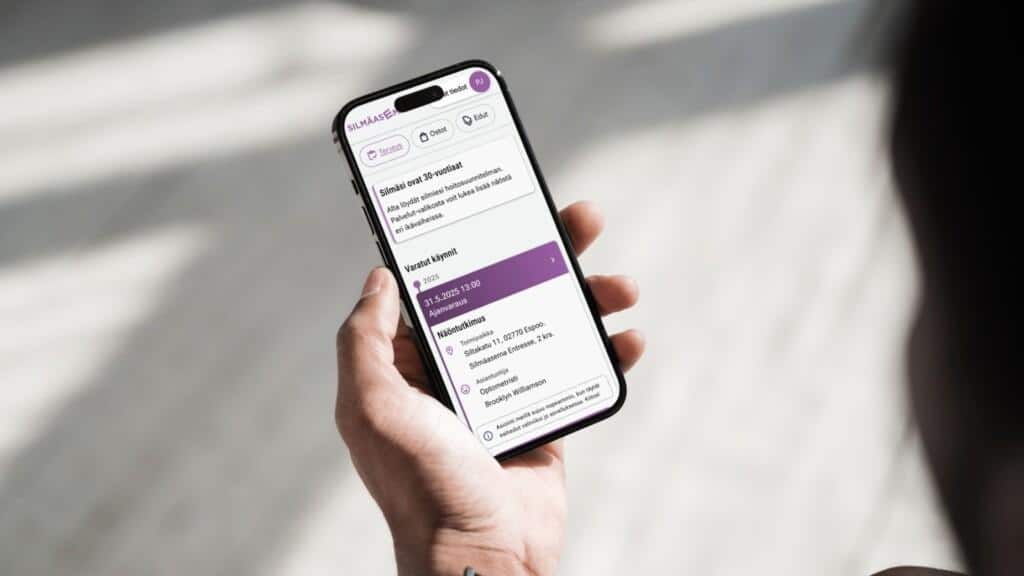
In practice, this meant developing the OmaSilmä app. The app brings together eye health and service-related information in one place, making it easily accessible and supporting everyday eye care. At the same time, it strengthens Silmäasema’s role as an expert and enables continuous engagement with customers between appointments. Today, OmaSilmä is one of the first applications in the field to combine purchase and health data into a single service.
From plans to launch
Silmäasema had already outlined plans for a consumer-facing service, but the project had not progressed into implementation. The challenge was not a single technical issue, but managing the overall complexity.
“There were several stakeholders involved, and the project required aligning different expectations and perspectives from both a customer experience and business point of view,” explains Katriina Haara, Service Designer at Silmäasema.
The project was built on top of a broad system landscape handling both customer and patient data. Healthcare regulation introduced strict requirements that needed to be considered from the very beginning. Together, these factors raised the threshold for launching the service.
Silmäasema needed a partner who could bring structure to the project and take development smoothly into production.
Clear roles and a phased approach led to a successful delivery
Codemate and Silmäasema moved forward step by step. An MVP approach was chosen, meaning the app was not built all at once. Instead, the most essential features were introduced quickly, tested extensively, and further developed based on feedback.
In the project, Silmäasema was responsible for product ownership and the business direction of the service, while Codemate handled design, user experience, and the technical implementation and architecture. This clear division of responsibilities kept the work focused and enabled smooth progress.
“The key was identifying what to do now and what to leave for later. By focusing on the right things, the project moved forward steadily and was successfully brought to completion,” says Jukka Toivonen, who led the project on behalf of Codemate.
The first version combined essential customer information and services: appointments, health data, and purchase history. The app gives customers visibility into their relationship with Silmäasema and guides them to take care of their eye health regularly in the best possible way.
Implementation: turning the concept into a working solution
During the implementation phase, the focus was on bringing together different systems, security requirements, and user experience into a cohesive whole. The solution needed to be reliable in everyday use while also meeting strict healthcare requirements.
Scalable architecture and integrations
The app was built using Flutter technology, enabling the development of both iOS and Android applications from a single codebase and supporting rapid further development.
At the core of the solution is an architecture that connects multiple critical backend systems, including sources of patient data, customer data, and business data, into one cohesive whole. At the same time, the solution needed to meet strict healthcare data security and regulatory requirements, which were taken into account from the very beginning.
“This was not about individual integrations, but about how the whole works together. Once the foundation was solid, changes could be made in a controlled way without breaking the overall system,” says Timo Pieti, Mobile Developer at Codemate.
Design system supports quality and continuous development
A design system was created during the project, forming the foundation not only for the app but also for other digital services at Silmäasema. It ensures a consistent user experience and enables controlled development across different environments.
“We built a component-based design system that allows changes to be implemented centrally and quickly,” says Petri Jomppanen, Designer at Codemate.
The design token-based approach enables fast UI updates, reduces duplicate work, and ensures a consistent brand experience across all digital channels, while also supporting long-term development.
Accessibility was also a key focus in the design, ensuring the service works as well as possible for all users.
“Dark mode was designed as part of the user experience from the start, making the app more comfortable to use in different situations and reducing strain on the eyes,” Jomppanen adds.
Iterative development and extensive testing ensured quality
Development was carried out iteratively, and the app was extensively tested before launch. The MVP version was introduced early for internal use, with around 500 Silmäasema employees participating in testing.
Feedback was collected systematically and fed directly into development, enabling rapid response and continuous improvement. At the same time, this ensured that the solution met both security and accessibility requirements.
A trust-based collaboration brought clarity to the project
A key factor in the project’s success was the way the collaboration was carried out. In a complex project, implementation alone is not enough – there must also be the ability to keep the overall work moving forward and decision-making clear.
Codemate’s team brought structure and clarity to the project, helping progress in a situation where the overall scope was complex and required aligning multiple stakeholders.
“The Codemate team convinced us from the start. They understood what we were aiming for and proposed clear solutions on how to move forward. The team worked well together, and everything progressed smoothly all the way to launch,” says Malmivaara.
Results and a foundation for future development
The app was successfully launched and quickly gained users without significant marketing efforts. Within the first few weeks, it reached thousands of downloads and active users. Initial feedback has been positive, providing a strong foundation for further development.
The most significant impact, however, can be seen in the customer experience. Customers can now take care of their eye health in one place and interact more smoothly both before and after appointments.
Collaboration with Silmäasema continues beyond the app. Codemate acts as a partner in several development initiatives, supporting the long-term development of Silmäasema’s digital services.
Tommi Malmivaara
Head of Digital, Silmäasema