
Since November 2025, a group of Aalto University computer science students has been working with Codemate on a software project with a twist. Instead of a hypothetical assignment, they’re building something real using Codemate’s GenUI solution Rebel AI Studio – something to help fellow students navigate everyday university life.
Three sprints in, the project has reached an interesting phase: the initial idea is taking shape, the team has found its rhythm, and the focus is shifting from “can we build this?” to “what should we actually build?”
Are you new to the series? Catch up with part 1 of Code Forward to see how this collaboration started.
Bringing scattered pieces together
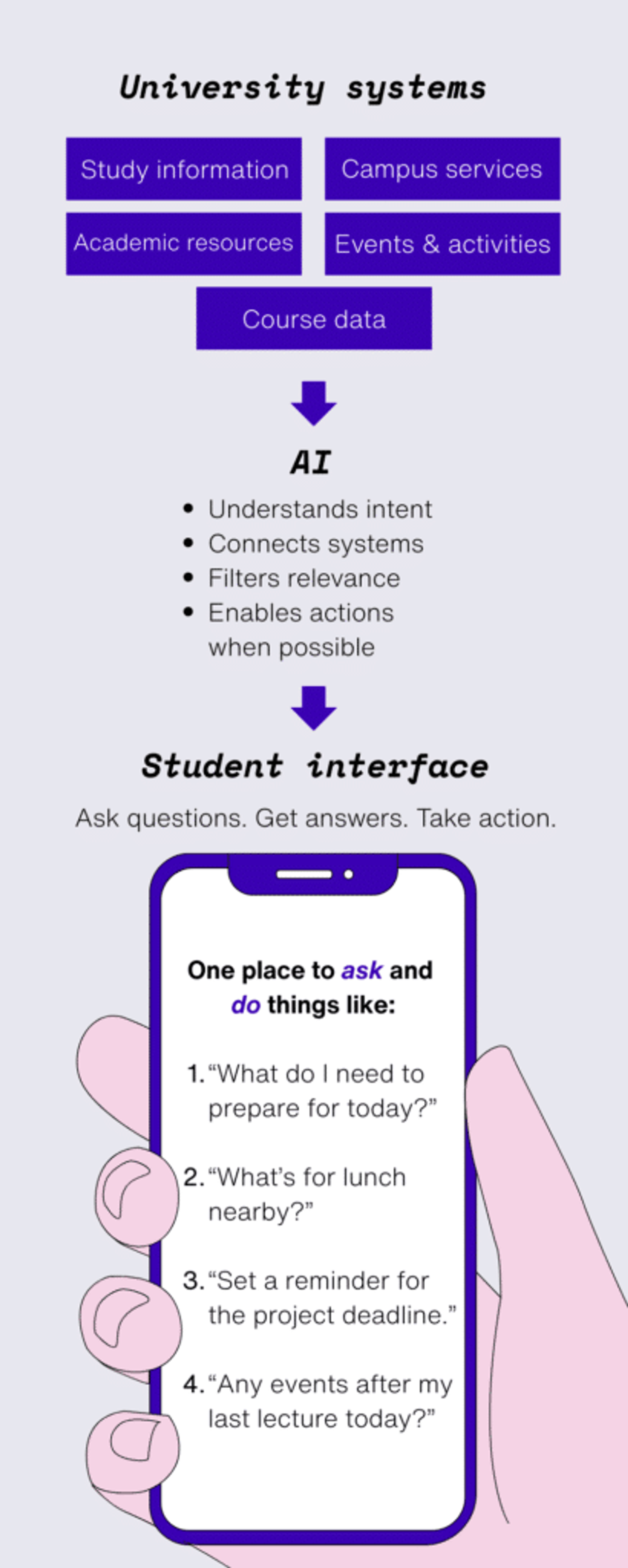
The software project, currently going by the working title “Aalto All Day and Night”, addresses a familiar university problem: information is everywhere and nowhere. Course details live in one system, practical campus information in another, study planning tools in a third. Students often know what they’re looking for, but not where to look.
The solution the students have been working on brings these pieces together into a single AI-powered interface, an AI assistant of sorts. Ask about today’s cafeteria menu, get course details, or find practical information without jumping between multiple services.
“The core idea is that we want to help students in their everyday life,” one student summarizes. “Planning your studies can feel a bit overwhelming at times, and we think this could be really useful”.
At this stage, the core functionality works. You can ask questions and get answers. However, as is the case in real-life software projects, making something work is just the starting point.
The team hits a stride
“The ball has really started rolling now,” says Ville Lindfors, Director of AI, Data & Cloud at Codemate. “The team is in full swing, and we’re able to test ideas and features that might eventually make their way into Rebel AI Studio itself.”
For Codemate’s mentors, this phase has been particularly valuable. Working with a team that’s learning the platform from scratch surfaces questions and assumptions that are easy to miss when you work with the same tools every day.
“We’ve learned a lot and we’ll continue to do so,” Ville adds. “That’s been one of the most valuable aspects of this collaboration, seeing how new developers encounter and use the platform.”
Now, halfway into the project timeline, the students have been getting up to speed with Flutter and Firebase while building on Rebel AI Studio’s foundation. Progress has picked up significantly as the initial learning curve has leveled out.
“It’s definitely been a learning curve since this is all new to us,” one student reflects on the progress so far. “Luckily, there have always been some resources and help available”.
Throughout the project, Codemate has offered AI tools for ideation, content creation, and coding – because that’s the reality of professional development today. The tools are there for students to use as they see fit, reflecting how developers work in real-world teams.
Shifting toward real needs
With the technical foundation in place, the team’s attention is turning to something more complex: understanding what students actually need and where the solution can genuinely help.
The focus is now on questions like: How do you make someone understand what the interface can do when they first open it? What should they see instead of an empty chat window? And more fundamentally, what information do students actually struggle to find?
The team is also exploring personalization, how the assistant could adapt to individual study programs, schedules, or preferences to make responses more relevant.
Course organization is emerging as a key area: which courses are offered, when, where, what are the prerequisites? This kind of information exists but requires piecing together from multiple sources. Making it accessible through a conversational interface could remove real friction from students’ everyday planning.
“We’re not just building features anymore, we’re shaping an experience based on actual student needs,” says Ville. “That shift is a clear sign the project has matured.”
What’s next
The next sprints will continue refining usability and exploring how the interface can better serve students’ day-to-day needs. The team is balancing technical development with user experience, testing assumptions, and discovering what actually makes a difference.
Whether through example prompts, onboarding flows, or smarter integration with existing university systems, the goal remains the same: making students’ everyday academic life a bit more manageable.
In the next part of Code Forward we’ll take a closer look at the final outcome and lessons learned.
